Cloud Infrastructure & Shifting Legacy Monoliths
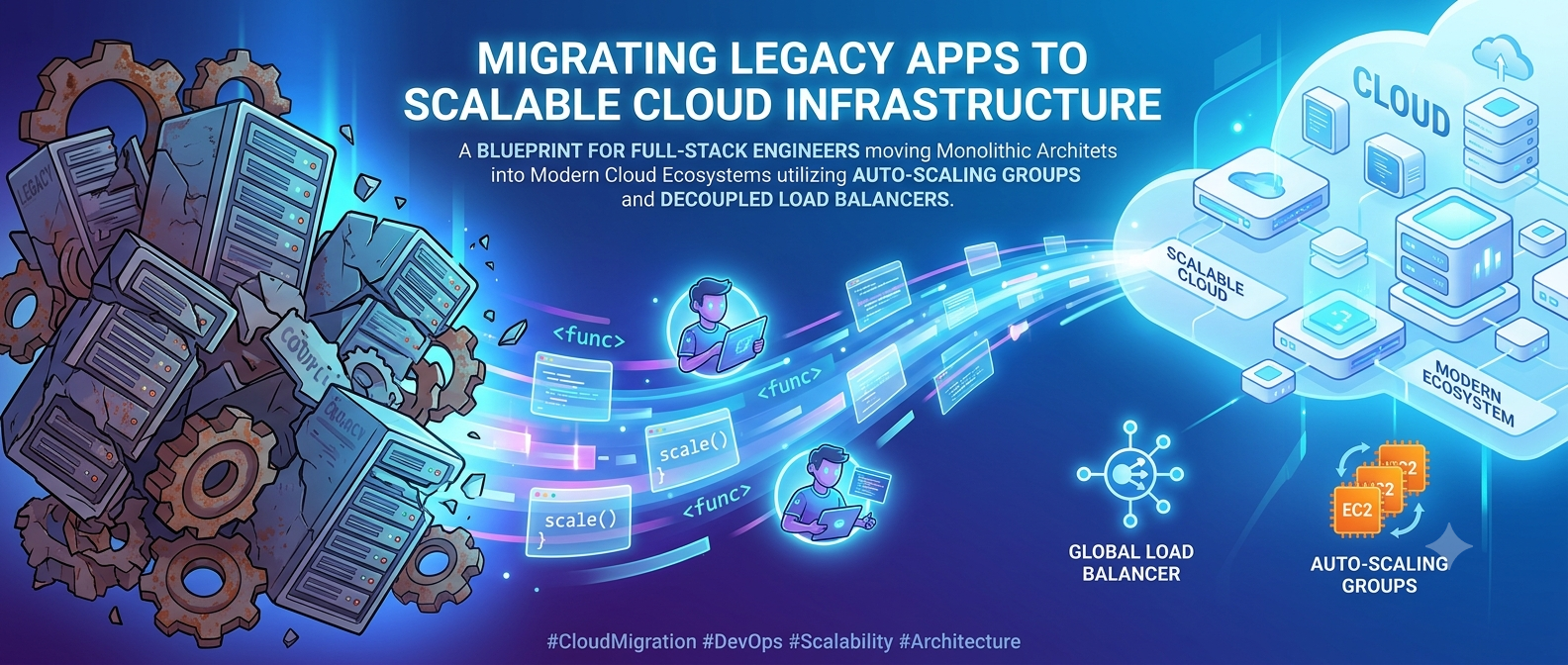
A blueprint for full-stack software engineers moving monolithic architectures into modern cloud ecosystems utilizing auto-scaling groups and decoupled load balancers.
Cloud Migration
Breaking the Monolith: Decoupling Legacy Application State for Elastic Scaling
Technical Deep Dive • 15 Min Read
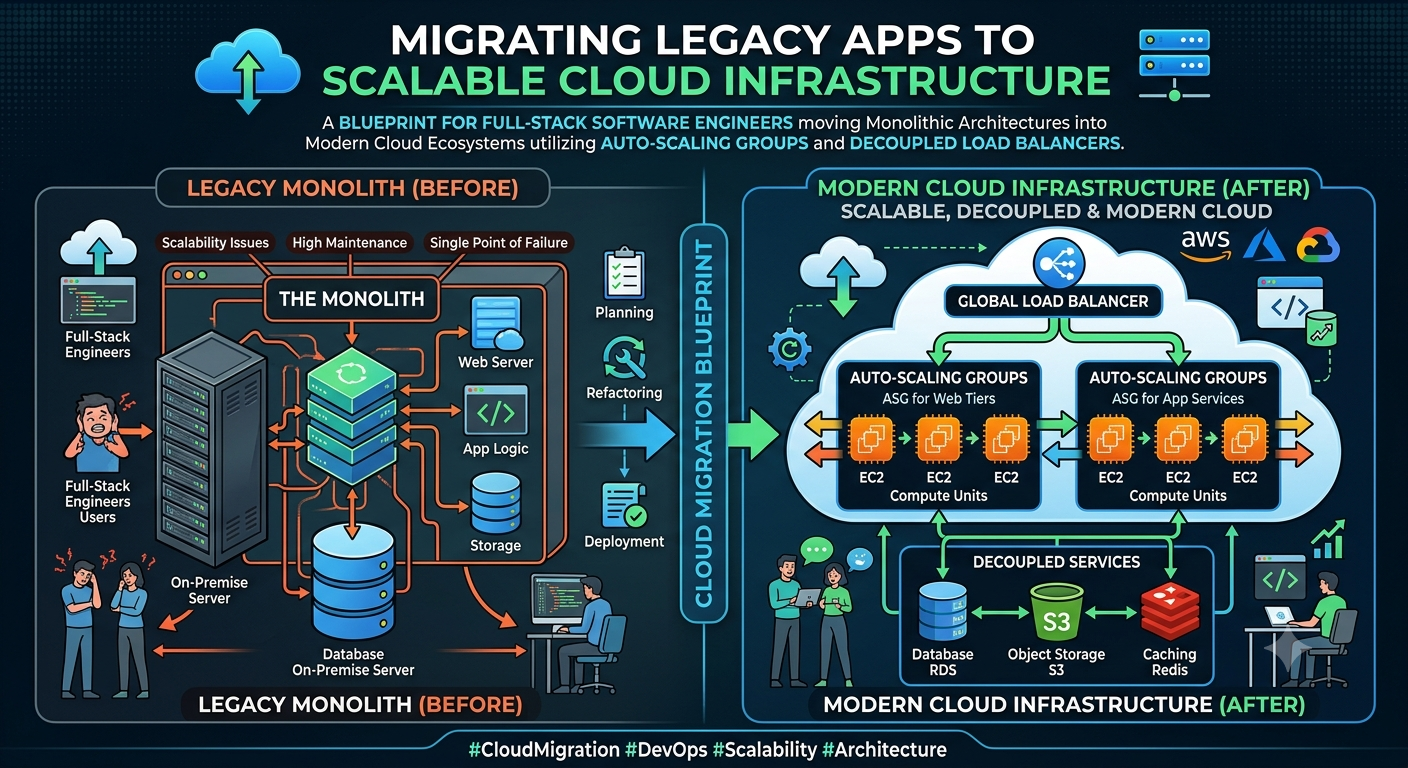
Why You Must Re-Architect Legacy Systems
Legacy applications often bundle the code, user file uploads, cache records, and primary database layers together inside a single, massive server instance. This makes scaling horizontally completely impossible, because multiplying server instances duplicates out-of-sync local file structures. Shifting to a stateless infrastructure topology ensures your core system nodes can be dynamically spun up or torn down by cloud auto-scalers based on real-time traffic volume.
The Roadmap to Stateless Applications
To transition cleanly, you must offload localized storage structures to object buckets (AWS S3/DigitalOcean Spaces) and shift session storage tasks over to an in-memory database cluster like Redis.
Decoupling Application Settings File Example (Laravel Cloud Configuration)
// Config mapping shifting local operations to distributed high-availability nodes
return [
    'default' => env('FILESYSTEM_DISK', 's3'),
    'disks' => [
        'local' => [
            'driver' => 'local',
            'root' => storage_path('app'),
        ],
        's3' => [
            'driver' => 's3',
            'key' => env('AWS_ACCESS_KEY_ID'),
            'secret' => env('AWS_SECRET_ACCESS_KEY'),
            'region' => env('AWS_DEFAULT_REGION'),
            'bucket' => env('AWS_BUCKET'),
            'endpoint' => env('AWS_ENDPOINT'), // Enables clean compatibility with self-hosted MinIO clusters
        ],
    ],
];
Infrastructure Migration Priority
Before touching container systems or build pipelines, verify your application framework handles database connection drops gracefully using native connection retries. This ensures a stable user experience during cloud replica failover elections.
Leave a comment
Your email address will not be published. Required fields are marked *