Hardening Reverse Proxy Permissions for Nginx and Apache Server Environments
Implement secure backend reverse proxy rules, sanitize header variables, and protect internal web application nodes from spoofing threats.

Server Operations
Hardening Proxy Routing Configurations: Securing Inbound Server Headers
Infrastructure Security • 11 Min Read
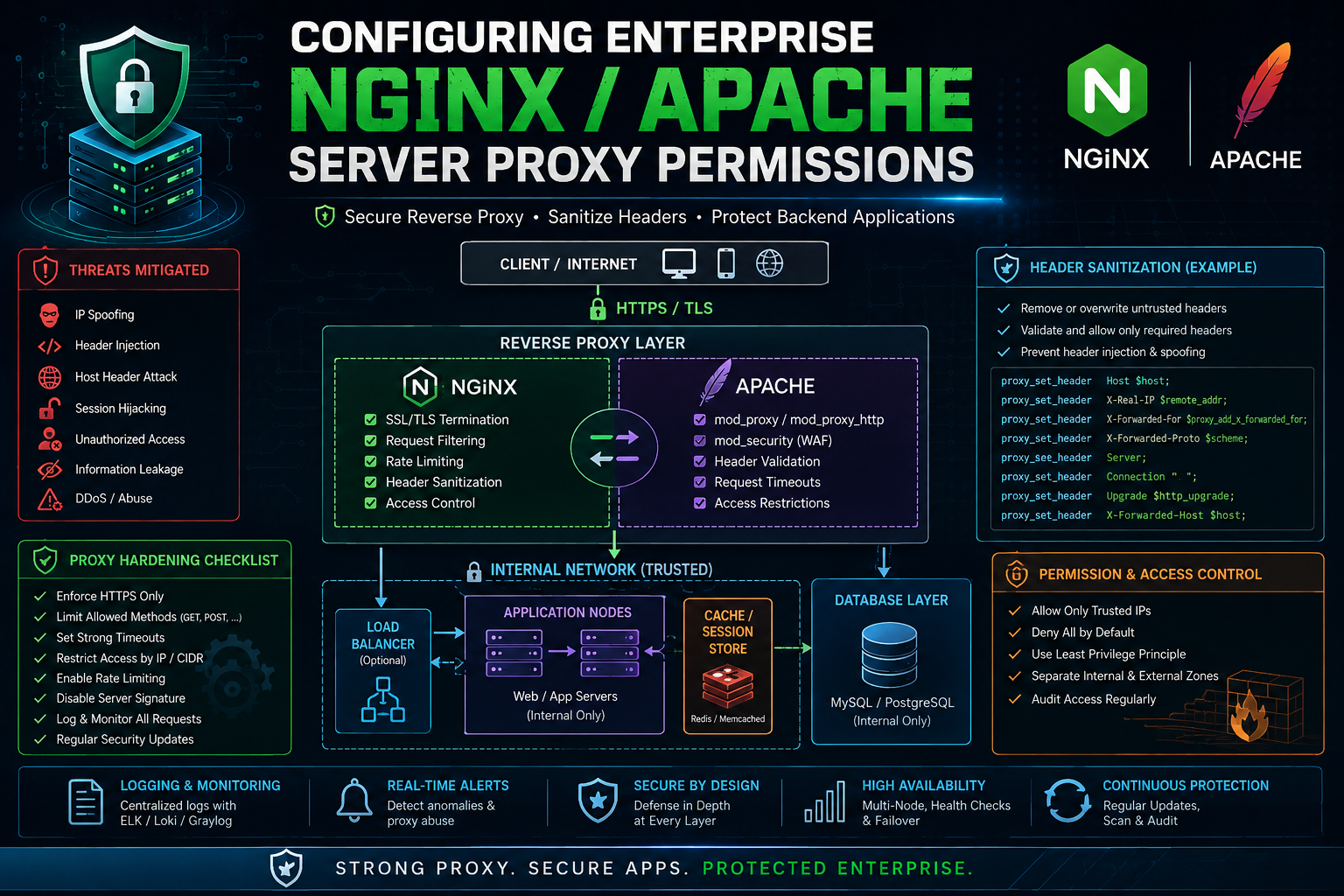
Why Raw Reverse Proxies introduce Security Flaws
Deploying a reverse proxy without explicit header sanitization can leave your backend applications vulnerable to IP-spoofing and request smuggling attacks. Malicious users can inject custom headers to trick internal application components into trusting fake client locations. Explicitly defining proxy permissions and downstream header rules ensures your internal server layout remains hidden and safe from outside manipulation.
Configuring Hardened Nginx Location Directives
Always wipe out unverified upstream headers and rebuild them using native server variables before proxying requests to internal backend ports.
Production Nginx Virtual Host Directive Block
server {
    listen 443 ssl http2;
    server_name api.app-gateway.internal;

    location /core-services/ {
        proxy_pass http://127.0.0.1:8080/;

        # Strip structural security claims injected by malicious external networks
        proxy_set_header X-Real-IP $remote_addr;
        proxy_set_header X-Forwarded-For $proxy_add_x_forwarded_for;
        proxy_set_header X-Forwarded-Proto $scheme;
        proxy_set_header Host $http_host;

        # Block potential HTTP Request Smuggling exploit entry vectors
        proxy_http_version 1.1;
        proxy_set_header Connection "";
    }
}
SysOps Recommendation
When using an upstream edge routing service like Cloudflare, always verify that your proxy layer maps client IPs exclusively through the official CF-Connecting-IP header map to protect your tracking metrics.
Leave a comment
Your email address will not be published. Required fields are marked *