Building High-Availability Centralized DNS Clusters for Web Hosting Panels
Learn how to engineer a resilient, centralized DNS cluster using BIND9 and PowerDNS to eliminate single points of failure in modern multi-tenant hosting environments.
Infrastructure & DNS
Architecting Centralized DNS Clusters for Zero-Downtime Web Hosting Panels
Technical Deep Dive • 12 Min Read 
Why Centralized DNS Clusters are Critical
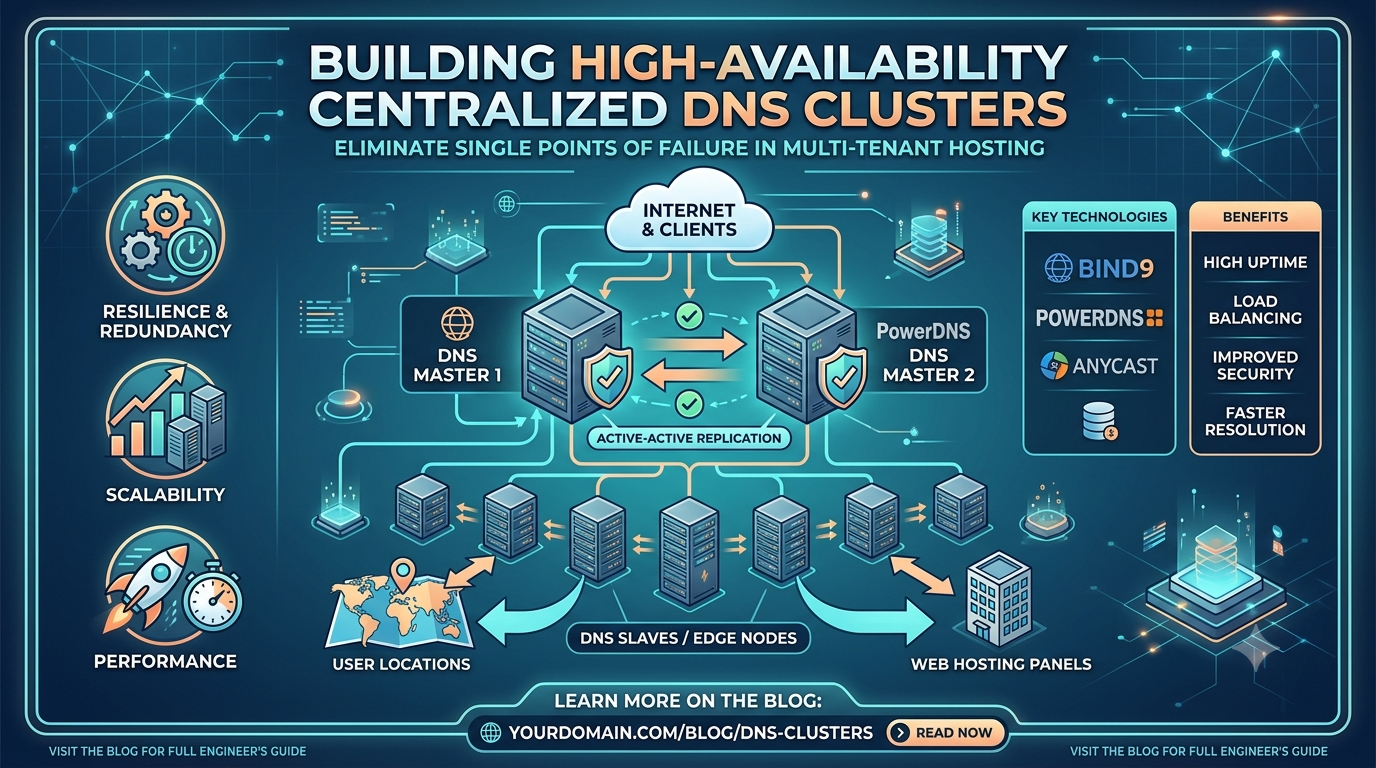
In standard legacy setups, web hosting control panels run their own local name servers on the same physical instance hosting the websites. If that server encounters a hardware crash or network timeout, the entire zone authority drops offline. A Centralized DNS Cluster decouples the DNS layer completely, syncing multiple geographically distributed redundant nodes. Even if your primary application server drops, global traffic routes gracefully without resolving timeouts.
How to Implement Master-Slave Zone Synchronization
The most resilient approach leverages a hidden master engine communicating via secure transaction signatures (TSIG) to broadcast RFC-compliant zone transfers (AXFR/IXFR) directly to global public-facing edge slave nodes (ns1/ns2).
Production-Grade BIND9 Master Configuration (named.conf.local)
// Secure TSIG key configuration for cluster authorization
key "cluster-sync-key" {
    algorithm hmac-sha256;
    secret "dGhlLXNlY3JldC1rZXktZm9yLWRucy1jbHVzdGVyLXN5bmM=";
};

zone "yourdomain.com" {
    type master;
    file "/var/cache/bind/db.yourdomain.com";
    allow-transfer { key "cluster-sync-key"; }; // Restrict AXFR data transfers
    also-notify { 192.168.10.11; 192.168.10.12; }; // Instantly alert Slave ns1/ns2 nodes
    notification-from-primary yes;
};
Architect's Recommendation
When migrating away from legacy web stacks, configure your custom hosting management API to push records dynamically into an SQL database backend driven by PowerDNS. This drops latency down to sub-milliseconds while making database clustering completely native.
Leave a comment
Your email address will not be published. Required fields are marked *