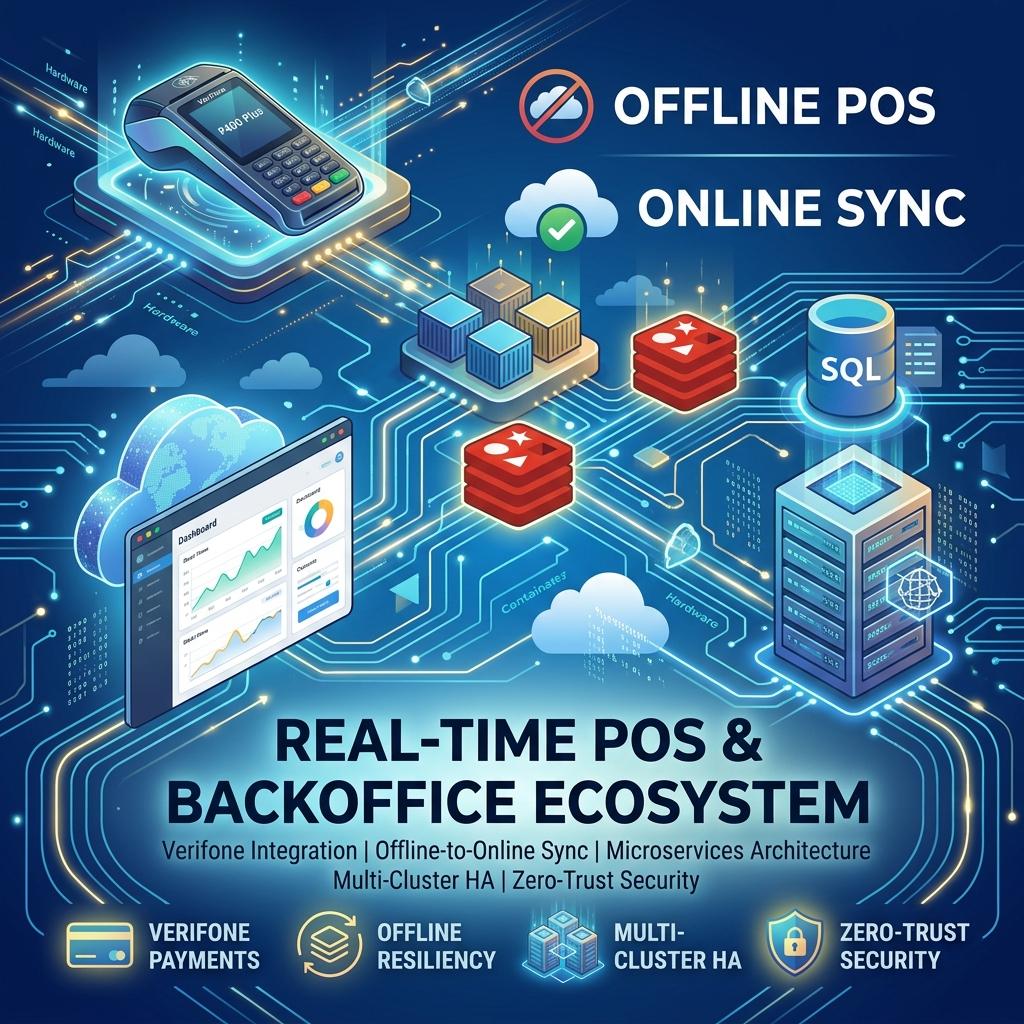
Real-Time POS & Verifone Backoffice Microservices Ecosystem
An enterprise-grade backoffice system connecting Verifone POS hardware and local client desktop applications to a high-availability, zero-trust cloud infrastructure—enabling seamless transition from offline POS transactions to real-time online synchronization.
1. Core POS Hardware & Backoffice System Architecture
This ecosystem seamlessly bridges physical Point-of-Sale (POS) hardware and Verifone payment terminals with a cloud-native backoffice application, transforming traditional local offline operations into a resilient online cloud synchronization workflow[cite: 1].
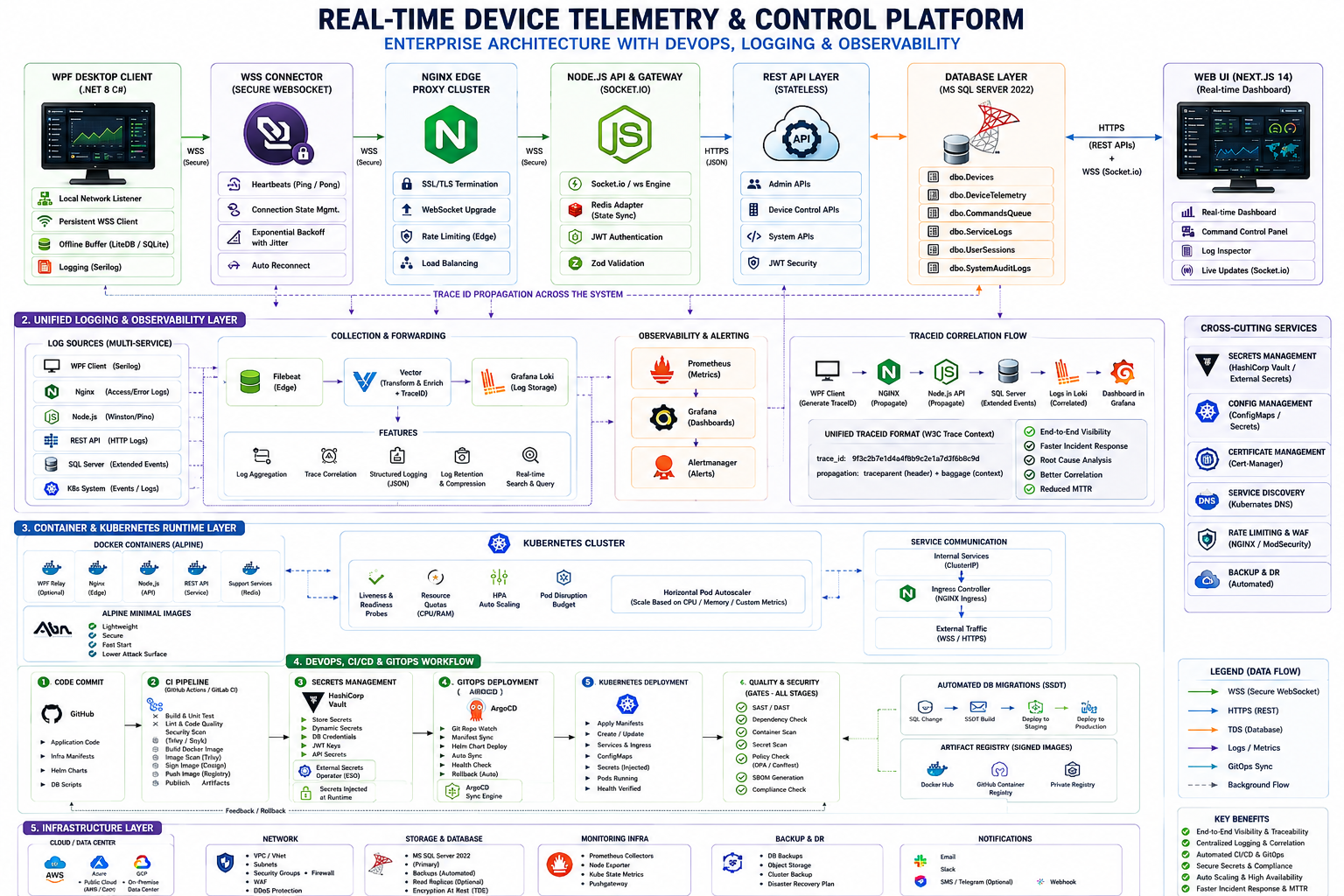
- Verifone POS Connector Integration: Binds to local network adapters (`192.168.x.x`) and serial interfaces to poll hardware peripherals, status telemetry, and transaction payloads directly from physical Verifone payment terminals[cite: 1].
- Offline App to Online App Transition Engine: When network connectivity drops, local transactions and telemetry are safely stored in an embedded LiteDB/SQLite buffer[cite: 1]. Once the internet is restored, the application auto-flushes queued records over persistent outbound WSS, instantly converting local offline operations into real-time online backend state[cite: 1].
- Nginx Proxy & Node.js Gateway Layer: Nginx terminates TLS 1.3, applies rate-limiting, and proxies WebSocket upgrade requests[cite: 1]. Node.js utilizes Socket.io and `@socket.io/redis-adapter` to distribute real-time POS events across Kubernetes pods, protected by Zod schemas and JWT device signatures[cite: 1].
- MS SQL Server 2022 Backoffice Database: Combines relational tables with `NVARCHAR(MAX)` JSON columns to store POS device records, terminal telemetry, command dispatch queues, and compliance logs in `dbo.Devices`, `dbo.DeviceTelemetry`, `dbo.CommandsQueue`, `dbo.ServiceLogs`, and `dbo.SystemAuditLogs`[cite: 1].
- Next.js 14 Backoffice Management Portal: A real-time command dashboard allowing backoffice operators to track live terminal statuses, dispatch remote testing payloads or configuration updates directly to POS clients, and run unified log searches[cite: 1].
2. Backoffice Infrastructure, DevOps & Observability
The platform employs GitOps, automated container supply-chain checks, and unified log aggregation to guarantee smooth rollouts and instant diagnostics across backoffice systems[cite: 1].
CI/CD & GitOps Automation
Pipelines run automated vulnerability scans with Trivy/Snyk, execute database schema migrations via SSDT, and deploy via ArgoCD while Vault injects runtime secrets[cite: 1].
Unified Log Aggregation
Aggregates Serilog POS logs, Filebeat, Winston, and SQL Extended Events into Grafana Loki using Vector, enabling complete transaction traceability with unique `TraceID` tokens[cite: 1].
Container & Pod Metrics
Lightweight Alpine Docker containers managed on Kubernetes with Horizontal Pod Autoscaling (HPA)[cite: 1]. Prometheus scrapes metrics, firing alerts if query latency exceeds 500ms or sockets disconnect en masse[cite: 1].
3. High-Availability Multi-Cluster Topology
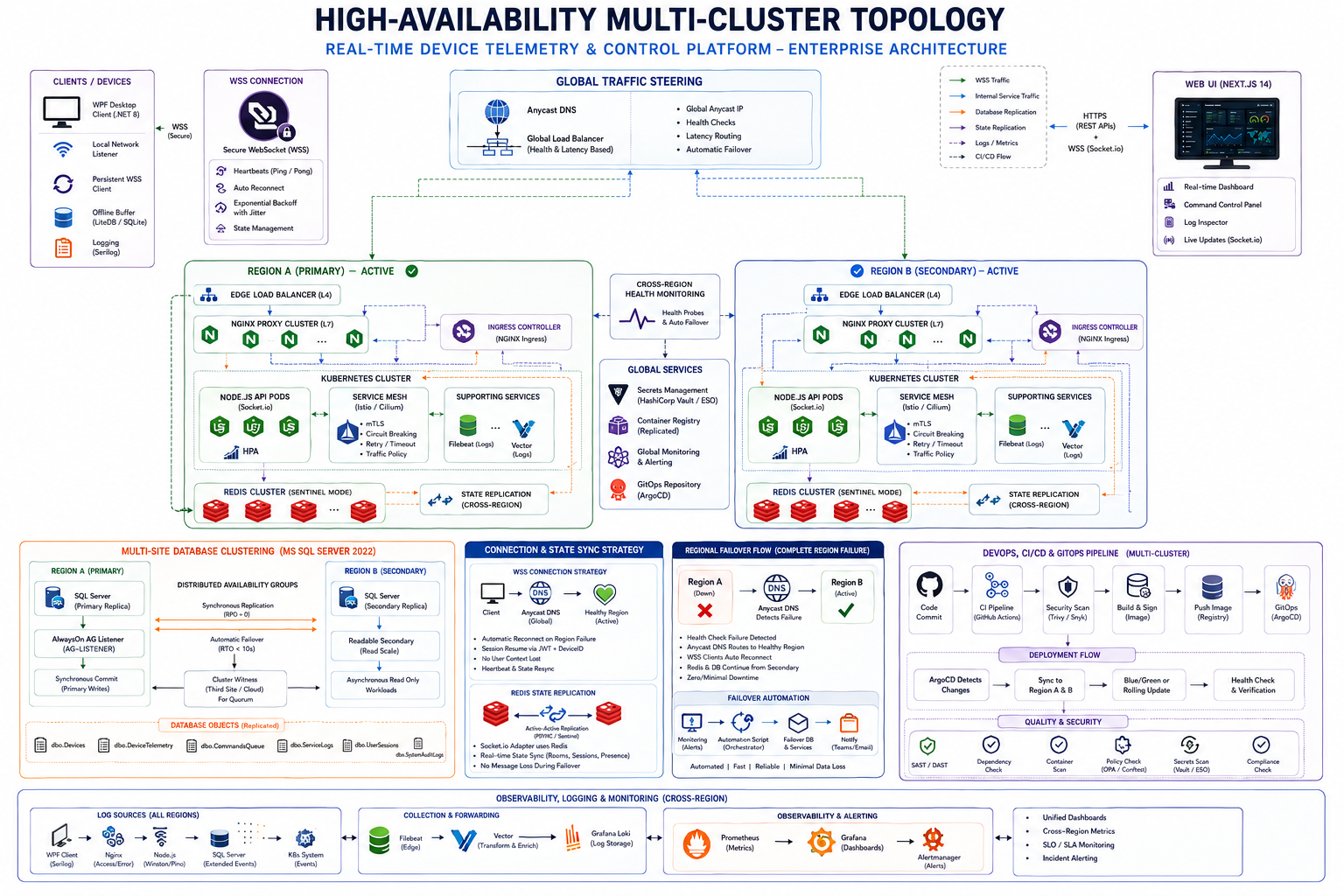
Built with active-active regional failover so backoffice services and online terminal synchronization remain operational even during regional cloud outages[cite: 1].
| Component | Region A Execution | Region B Execution |
|---|---|---|
| Global Routing | Anycast DNS balances incoming POS client connections across healthy regional clusters[cite: 1]. | |
| Worker Clusters | Kubernetes worker cluster managing Node.js microservice pods behind an Istio service mesh[cite: 1]. | Identical Kubernetes cluster accepting failover traffic and online POS synchronization requests[cite: 1]. |
| MS SQL AlwaysOn AG | Primary Replica processing synchronous database writes for incoming transactions[cite: 1]. | Secondary Replica via Distributed Availability Groups (RPO=0, RTO < 10s)[cite: 1]. |
4. 5-Zone Zero-Trust Security Framework
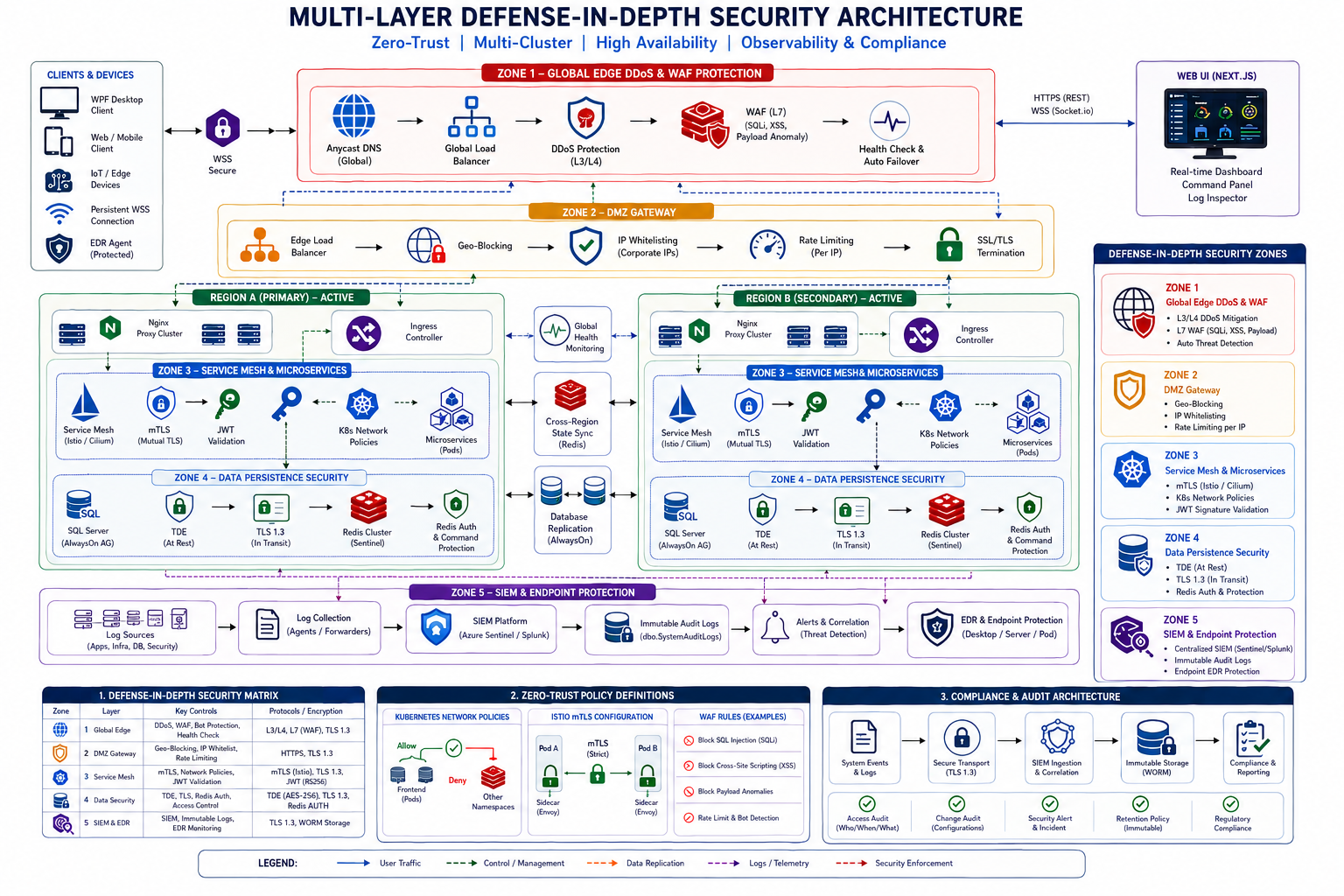
To safeguard sensitive point-of-sale data and backoffice operations, security policies are strictly enforced across five isolated zones[cite: 1].
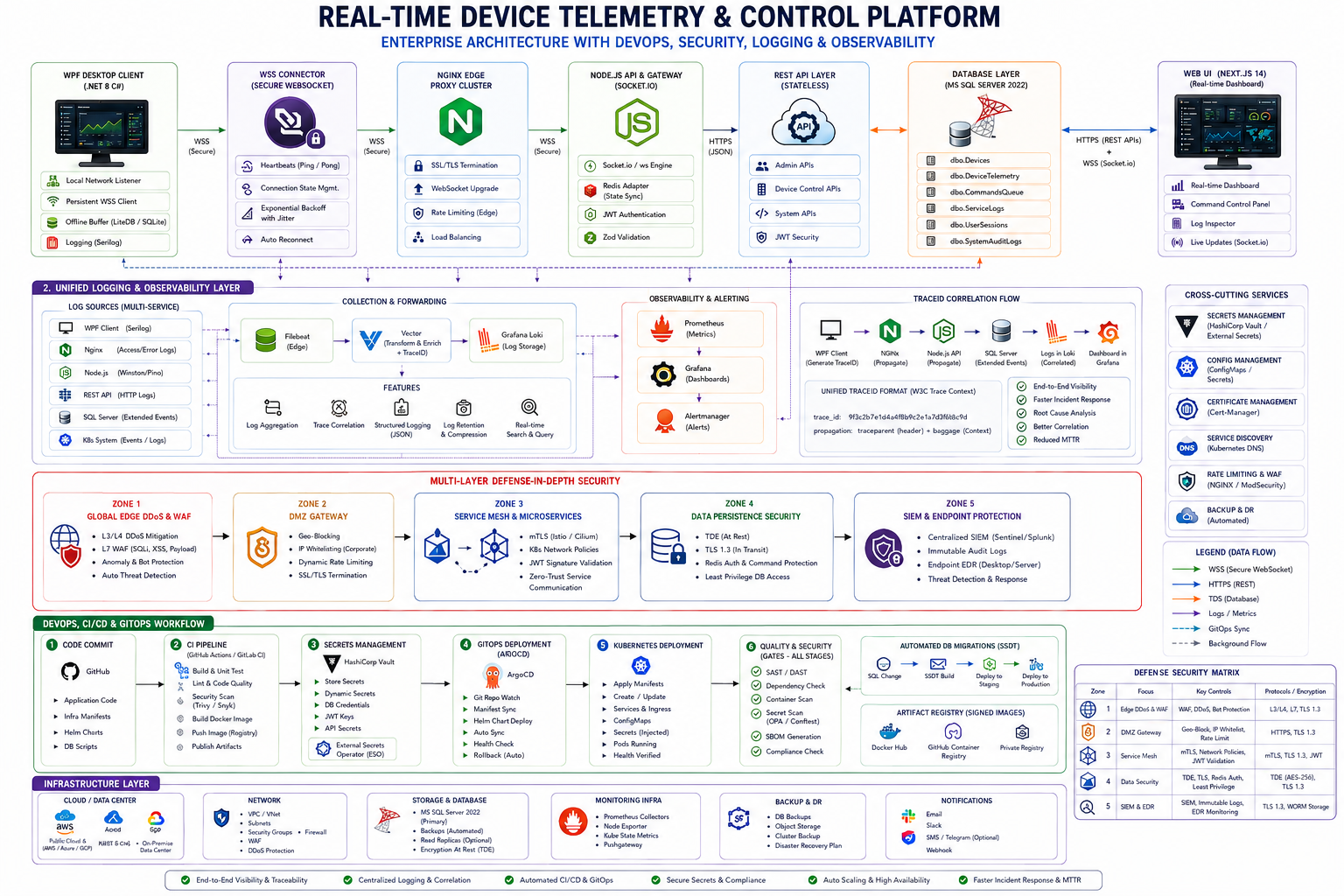
Zone 1: Global Edge WAF & DDoS Protection
Mitigates volumetric SYN/UDP floods and inspects incoming HTTP/WSS requests for SQLi, XSS, and payload anomalies[cite: 1].
Zone 2: Edge Gateway Security & Filtering
Enforces dynamic rate limiting per IP, geo-blocking policies, and corporate network whitelists[cite: 1].
Zone 3: Microservice Mesh & Network Isolation
Restricts inter-pod communication with Kubernetes Network Policies and enforces Mutual TLS (mTLS) via Istio/Cilium[cite: 1].
Zone 4: Persistence Security & Encryption
Protects stored backoffice records using MS SQL Transparent Data Encryption (TDE) and enforces TLS 1.3 transport encryption for DB drivers[cite: 1].
Zone 5: SIEM Auditing & Endpoint EDR Protection
Streams security logs to SIEM platforms (e.g., Azure Sentinel) and protects client desktop binaries with local EDR agents[cite: 1].
This project showcases a complete POS backoffice system—bridging local Verifone hardware terminals with a scalable, zero-trust cloud architecture to ensure uninterrupted, offline-resilient online operations.